No. 001
Everything except the thinking
3 min readCurated by Olcay Kurtulus
SoCrea exists to ask one question of everything it reads: how does creative work actually get made now that AI is in the room? We hold ourselves to the same standard we hold our sources, so the first issue starts with a mistake of our own. The rubric and methodology are public, and the rejections are at the end, where they will be every week.
The first thing our tool flagged was us
Before this issue existed, we built a small free tool: the Token Auditor. Paste your design tokens, and it returns a contrast matrix for light and dark themes, references that resolve nowhere, and pairs of tokens that are functionally the same color. It runs in your browser and uploads nothing. Naturally, the first token set we fed it was our own. Seven tokens, built carefully, reviewed twice, already covered by tests.
It found three problems.
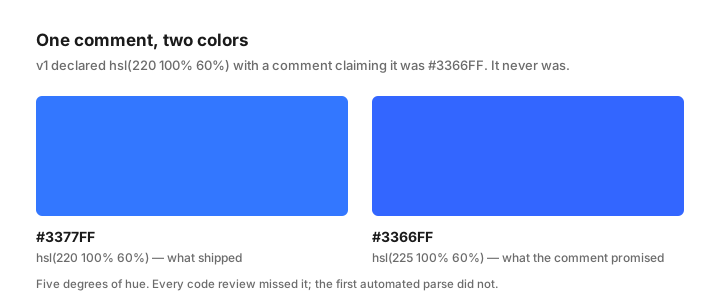
The first had been hiding for sixteen months, across two codebases. Our primary token was declared as hsl(220 100% 60%), with a comment asserting it was the brand blue, #3366FF. It is not. That hue is #3377FF, eleven points of green away. The comment and the value were written together, trusted together, and copied together into the rebuild, where the comment kept vouching for a color the value never produced. No human caught it, and humans looked many times. A unit test written while building the parser caught it in its first run.
The second and third problems were more uncomfortable, because nothing about them was a typo. Run against WCAG's arithmetic, our brand blue reads 4.7:1 on white but 3.7:1 on our dark surface. The brand pink is the mirror image: 4.9:1 on dark, 3.5:1 on white. Each brand color passed accessibility in exactly one theme, and every check we had performed before building the tool had happened to look at the passing one.
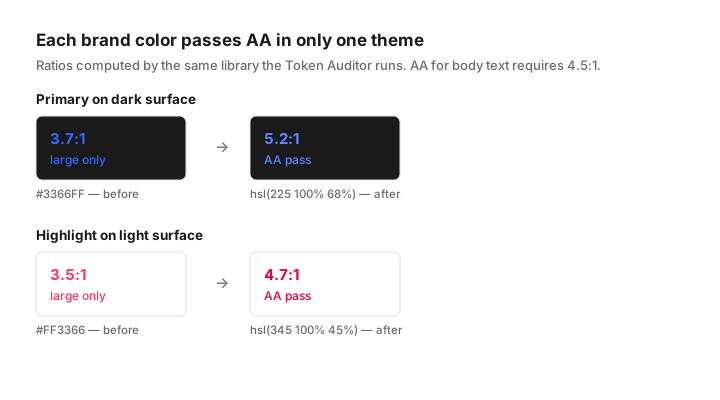
The fix was not to abandon the brand colors but to admit they are text in one theme and decoration in the other: each theme now gets the exact brand hex where it passes, and the nearest same-hue variant where it does not. A test now recomputes every text token against its surface on every change, so the mistake class is closed, not just the instance.
The craft point is the one this publication exists for. "The system looks right" survives an unlimited number of reviews, because looking right is what reviews check. The lie in our token file was not visible; it was legible, and only to a machine that reads values instead of impressions. The judgment about what to do with the finding stayed human. The finding itself never would have arrived by judgment alone.
Comments lie and hex values do not: if seven careful tokens hid a sixteen-month falsehood and two accessibility failures, assume your tokens are hiding more, and let something that cannot be charmed read them.
The exploration is quietly disappearing
The craft chapter of the AI in Design Report 2026, from Designer Fund and Foundation Capital, surveys more than 900 designers across 60-plus countries. The headline numbers: 91 percent now use AI weekly, and half report shipping AI-generated code.
The number that matters is neither. It is an aside from Nick Inzucchi, product designer at Cursor, about what code-first working does to the shape of thinking:
Code forces you to commit to your first idea and go deep—at the expense of the broad exploration that Figma made easy.
That is the craft finding of the year so far, hiding in a report about productivity. Divergent exploration, the cheap sketching of many bad options before choosing one, was never a deliverable, so no metric notices when it disappears. The report is honest enough to print the tension next to its own adoption statistics, which is exactly why it earned a place here.
Worth your time for the quotes, not the percentages: it documents the moment speed started costing breadth, in the words of people paid to notice.
Many desks, one pattern
How designers actually work with AI in 2026 does the thing almost nobody does: it names over a dozen working designers and describes their actual setups. An agency run from markdown context files. A "Brand DNA" document built so any model, present or future, can produce on-brand output. One designer who built an adversarial QA agent whose only job is to attack his work before a client sees it.
Read together, the setups agree on one thing, and a dissenting voice in the piece says it plainly: AI sped up everything except the thinking. Proposing solutions has become nearly free. Judging them has not. Every serious setup in the piece is, one way or another, an attempt to protect the judgment step from the flood of cheap proposals. Our lead story is the same pattern from the other side: the machine surfaced the findings, and the only part that could not be delegated was deciding what they meant.
The most concrete picture of the new working day we have found: less a tool list than a stack of small essays on where human attention still has to sit.
Considered, and not included
- Automating Design Systems with AI (Parallel) — Cites studies we could not find anywhere; precise statistics attributed to journals that do not appear to exist. (evidence)
- Workflow Lab: Expanding the Canvas (Figma) — The workflow shape is real, but the case study is a fictional company. Vendor marketing, not documentation. (evidence)
- AI in Design (Devlin Peck) — A genuinely useful practitioner guide covering the same ground as our third item, with less reporting. (novelty)
- Typography trend roundups (three separate ones) — What is trending, never how the work gets made. One managed not to name a single typeface. (craft insight)