No. 002
Ready to build on
3 min readCurated by Olcay Kurtulus
Our first issue argued that your design system now has a second audience, one that reads values instead of impressions. This issue is about the contracts that audience reads: one standard that just became real, one that will not be real for years, and what production looks like in between. Two questions for the curator close the issue, a new segment: named answers from the person accountable for every verdict here.
The tokens got their standard
On 28 October 2025, the W3C Design Tokens Community Group shipped version 2025.10, the first stable release of the vendor-neutral token format, after years of drafts. More than twenty editors put their names on it, from Adobe, Google, Meta, Microsoft, Figma, Sketch, Salesforce, and the New York Times among others, and over ten tools already implement it, including Style Dictionary, Tokens Studio, Penpot, and Figma itself.
The contents are what a working system needs rather than a committee's wishlist: modern color spaces (Display P3, Oklch), theming and multi-brand support, token relationships with inheritance and aliases. The craft point follows from the first issue directly: a machine-readable format is now a stable, portable contract, which means "the agent could not parse my tokens" is finishing its run as an excuse.
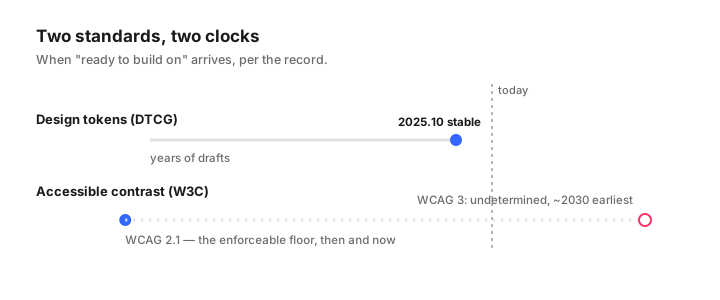
The rare standard that shipped because the tools converged first: adopt the format, and stop writing bespoke token parsers anyone else will have to reverse-engineer.
What production actually looks like
The CTO guide to Figma MCP is the least romantic account of design-to-code agents we have found, which is its value. The centerpiece is a monday.com production case: an eleven-node agent workflow whose generated output initially ignored the design system entirely, until the team built custom enforcement tooling around it. Around the case study sit the unglamorous practicalities: server setup, the remote-versus-desktop trade-off, and Code Connect mapping. The guide also does what vendor content never does: publishes failure rates, per-generation costs, and two CVEs.
Put next to the item above, it completes the thought. A stable token format is the precondition for agents respecting your system; it is not the mechanism. The mechanism, on present evidence, is rails you build yourself and tests that fail loudly.
Read it before your team proposes an agent pipeline: the gap between the demo and the monday.com case is the part you will be budgeting for.
The standard that is not ready
Adrian Roselli's status check on WCAG 3 contrast is short, dated, and quietly damning: APCA, the perceptual contrast method widely assumed to be the future, remains a candidate, not a standard. It was removed from the WCAG 3 Working Draft in 2023, the contrast algorithm is formally undetermined, and WCAG 3 itself is estimated at around 2030 or later. His advice: treat WCAG 2 as the floor, and document any divergence deliberately.
Disclosure, since it is on point: our own Token Auditor computes WCAG 2.1 arithmetic for exactly this reason. Perceptual models are better science; the enforceable number is still the 2018 one.
Bookmark it for the next time someone calls WCAG 2 obsolete in a design review: the replacement does not exist yet, and the person maintaining that fact most carefully holds no W3C role at all.
Two questions for the curator
SoCrea is curated by Olcay Kurtulus, who builds design tooling. Answers are the curator's own.
The Design Tokens spec went stable after years of drafts, while WCAG 3's contrast method may not settle until 2030. How do you decide when a standard is ready to build on?
I watch the tools, not the committee. A standard is ready when independent implementations converge on the same behavior, because that convergence is what you are actually depending on. The tokens spec crossed that line before the ink dried: ten tools shipping is the ratification that matters. Contrast went the other way. The Token Auditor runs WCAG 2.1 arithmetic because that is the number a contract and a court both understand, and I will not gate anyone's build on a candidate algorithm. The arithmetic is one small module; when the standard settles, swapping it is a version bump.
What is one design decision you refuse to hand to a model, and one you were surprised to find you could?
I keep the meaning. What a color communicates, what is worth a reader's time, what ships under my name: that stays human, because it is the product. What surprised me was how gladly I handed over finding my own mistakes. Our tool caught a brand hue that had been wrong for sixteen months and two contrast failures I had reviewed past many times. Machines read values; I read impressions.
Considered, and not included
- What's new in the Design Tokens spec (zeroheight) — The page contains no article: navigation, product cards, and calls to action under an editorial headline. (evidence)
- Enterprise AI-agent governance playbooks (a wave of them) — Compliance org charts and audit trails; nothing about how creative work gets made. Screened at intake. (fit)